
Firecrawl Headless Clay Gives You 33 Free Work Emails a Month. Spend Them Well.
On November 2, Firecrawl shipped something it calls headless Clay for agents. The claim: run your lead enrichment flows inside ChatGPT or Claude. Search 250 million people and 26 million companies, pull work emails and company data, get 1,000 free credits a month, and “pay 88% less than Clay at scale.”
It’s the first recipe in this cookbook that somebody who has never opened a terminal can run.
I already knew most of what was behind it. Last month I read the terms for every paid provider behind Universal Scrape, and Apollo and FullEnrich were on that list. What the launch page leaves out is the price list. So I pulled it from the catalog. The search is free. Almost everything after the search costs 30 credits. Do that math against 1,000 free credits and you get about 33 work emails a month.
It’s enough to work out who’s worth emailing, if you do the searching before the spending. That’s the recipe.
- What “Headless Clay” Is
- The Price List the Launch Page Left Out
- The Recipe: Search Free, Qualify in Chat, Pay for Five
- You Couldn’t Scrape LinkedIn. Now You Can Buy It in Chat.
- The Fine Print Comes With the Emails
- Is It Really 88% Cheaper Than Clay?
- Why Not Just Use Apollo’s Own Connector?
- Where This Leaves the Recipe
What “Headless Clay” Is

Under the hood it’s Alexandria, the catalog of data providers Firecrawl has been building since late September. firecrawl list people --category returns 20 providers. The enrichment ones are Apollo, FullEnrich, Hunter, People Data Labs, EnrichLayer, BlitzAPI, Crustdata, Icypeas, LeadOcean, Moltsets, QuickEnrich, Sixtyfour and Data Legion, plus four email verifiers (Filtrat, MillionVerifier, Scrubby and TrestleIQ). Universal Scrape already exposed these on October 8. The new part is a chat connector instead of a command line.
The odd thing is that the Claude connector doesn’t list a single people tool. It lists 13: firecrawl_search, firecrawl_scrape, firecrawl_find_tools, firecrawl_search_feedback, firecrawl_developer_search, firecrawl_gov_search, three agent tools and four research-paper tools. So the enrichment has to go through the general-purpose tools. Firecrawl’s own people enrichment post points at firecrawl_find_tools plus firecrawl_search with Alexandria as a source.
When I asked Claude afterward which tools it had called, it was firecrawl_find_tools twice (once to find “Apollo people search,” once to pull that capability’s full contract) and then firecrawl_scrape three times, each with an alexandria body naming provider: "apollo" and capability: "people/search". The people lookup uses the scrape tool, which you would never guess from the connector’s tool list.
The Price List the Launch Page Left Out
Every tool in the catalog carries its credit cost. These are the two providers that matter most for this recipe:
| Provider | Call | Credits |
|---|---|---|
| Apollo | people/search | 0 |
| Apollo | people/match (unlock one person’s contact info) | 30 |
| Apollo | people/bulk-match (up to ten people) | 30 per matched person |
| Apollo | companies/enrich, companies/search (per page), companies/job-postings, companies/news | 30 |
| FullEnrich | people/search | 5 per record |
| FullEnrich | people/lookup | 10 |
| FullEnrich | contacts/work-email | 30 |
| FullEnrich | contacts/personal-email | 100 |
| FullEnrich | contacts/mobile | 300 |
Apollo’s description of its own search tool: “Always start here. It is free and it tells you who exists before anything is spent. Never match a list of guesses: search, read the previews, then match only the people worth revealing.”
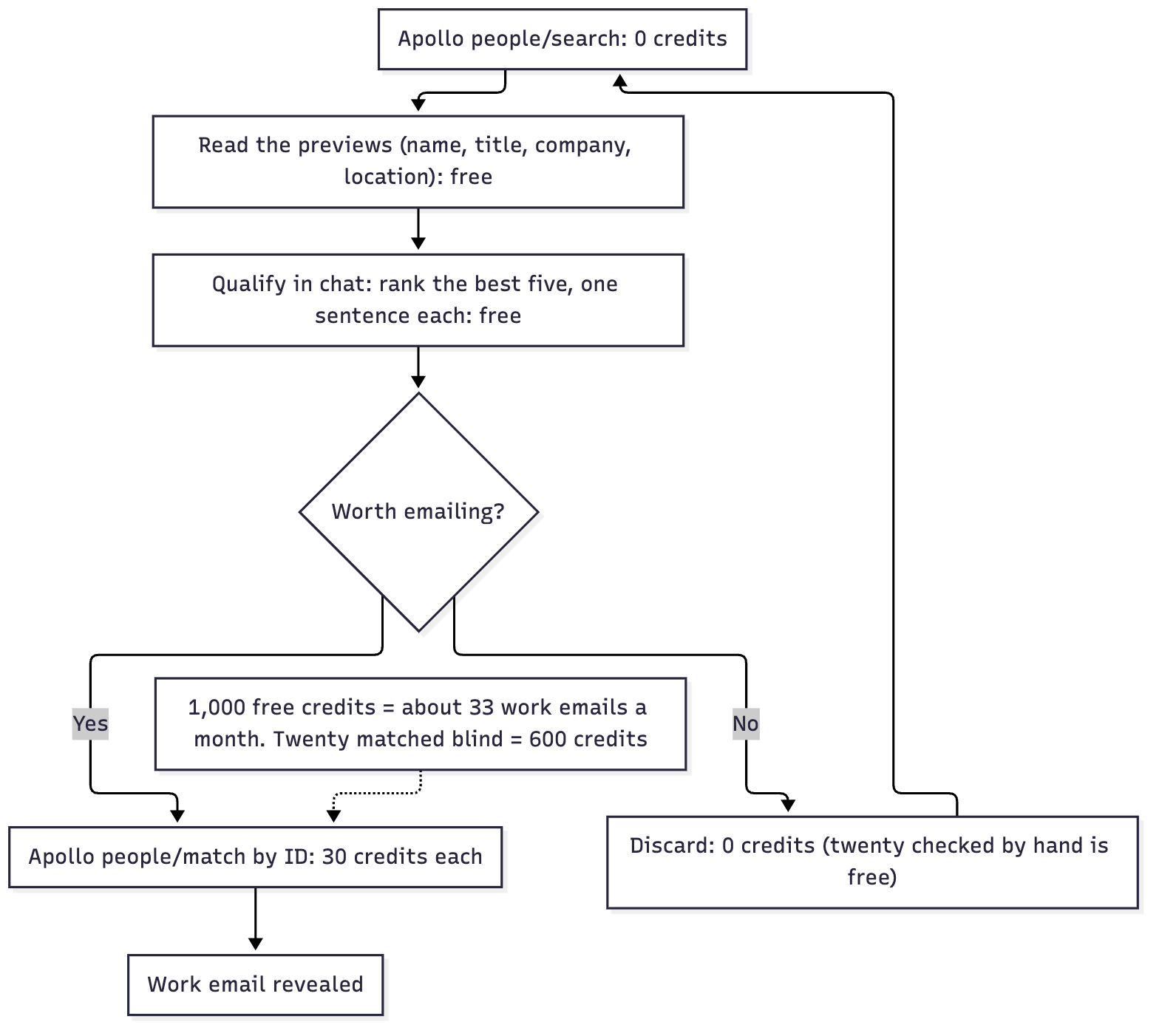
1,000 credits is 33 Apollo matches or 33 FullEnrich work emails. Or three mobile numbers. One prompt like “find me 50 marketing directors in Austin and get their emails” spends the month on the first 33 and stops.
The Recipe: Search Free, Qualify in Chat, Pay for Five
The idea is to use the free call first. You see who exists. You read their titles and companies and throw away ones that don’t fit. Then spend 30 credits on each person you’d email.

Step 1: Connect the connector
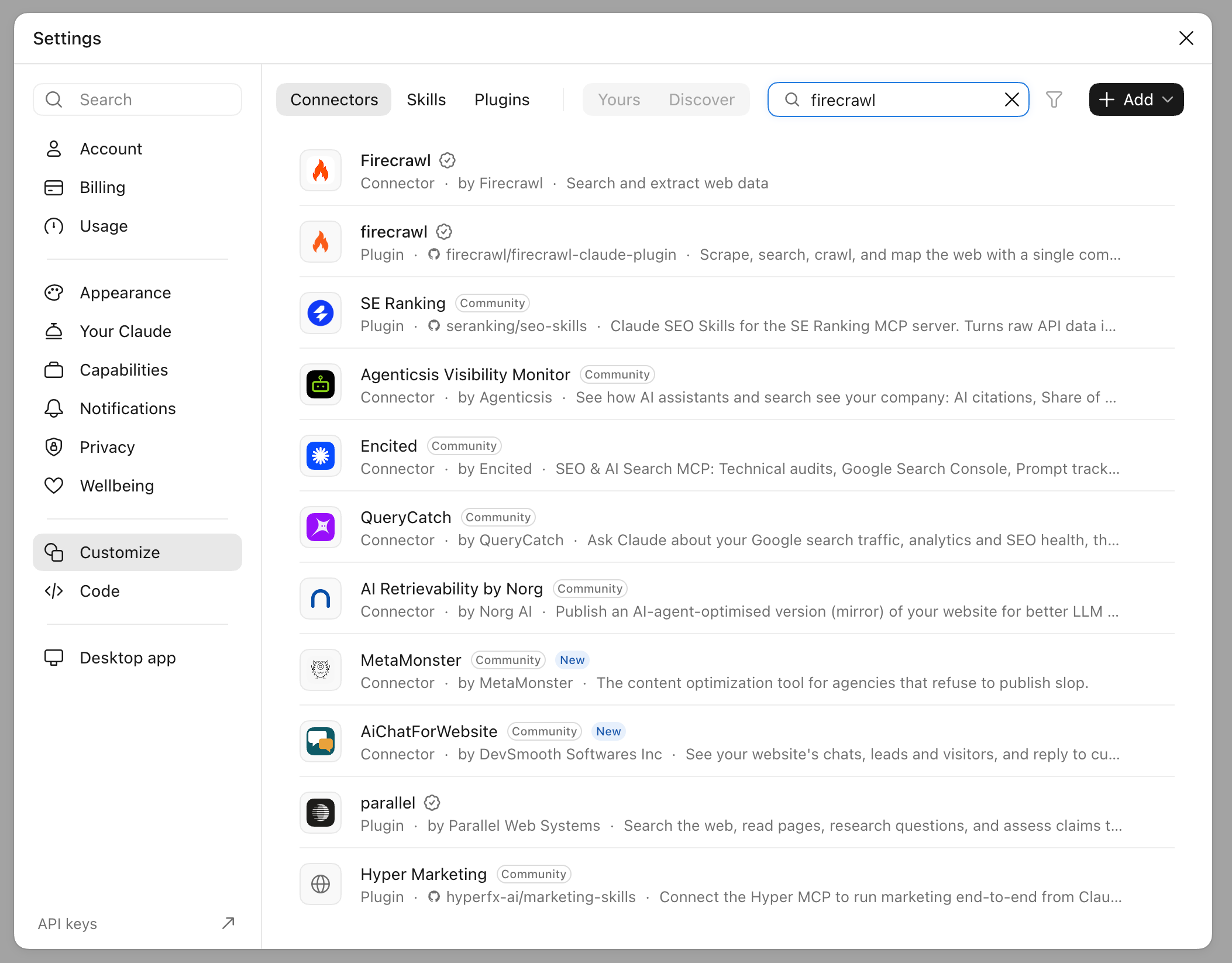
In the Claude desktop app, go to Settings → Customize and search for “firecrawl”. Two things come up, and they both have the Firecrawl flame. The one you want says Connector · by Firecrawl. The other one is a Plugin pulled from the firecrawl/firecrawl-claude-plugin GitHub repo, and that one is for Claude Code. It talks to the same Firecrawl server and adds a pile of ready-made skills on top, including find-leads and enrich-lead, which are this recipe packaged up. If you live in a terminal, that’s worth a look. For the chat app, take the connector.
Click the connector and you land on its page. The description is the only place in Claude that tells you this connector can “discover structured data providers,” which is the Apollo and FullEnrich catalog. It also promises “account credit-usage checks.”
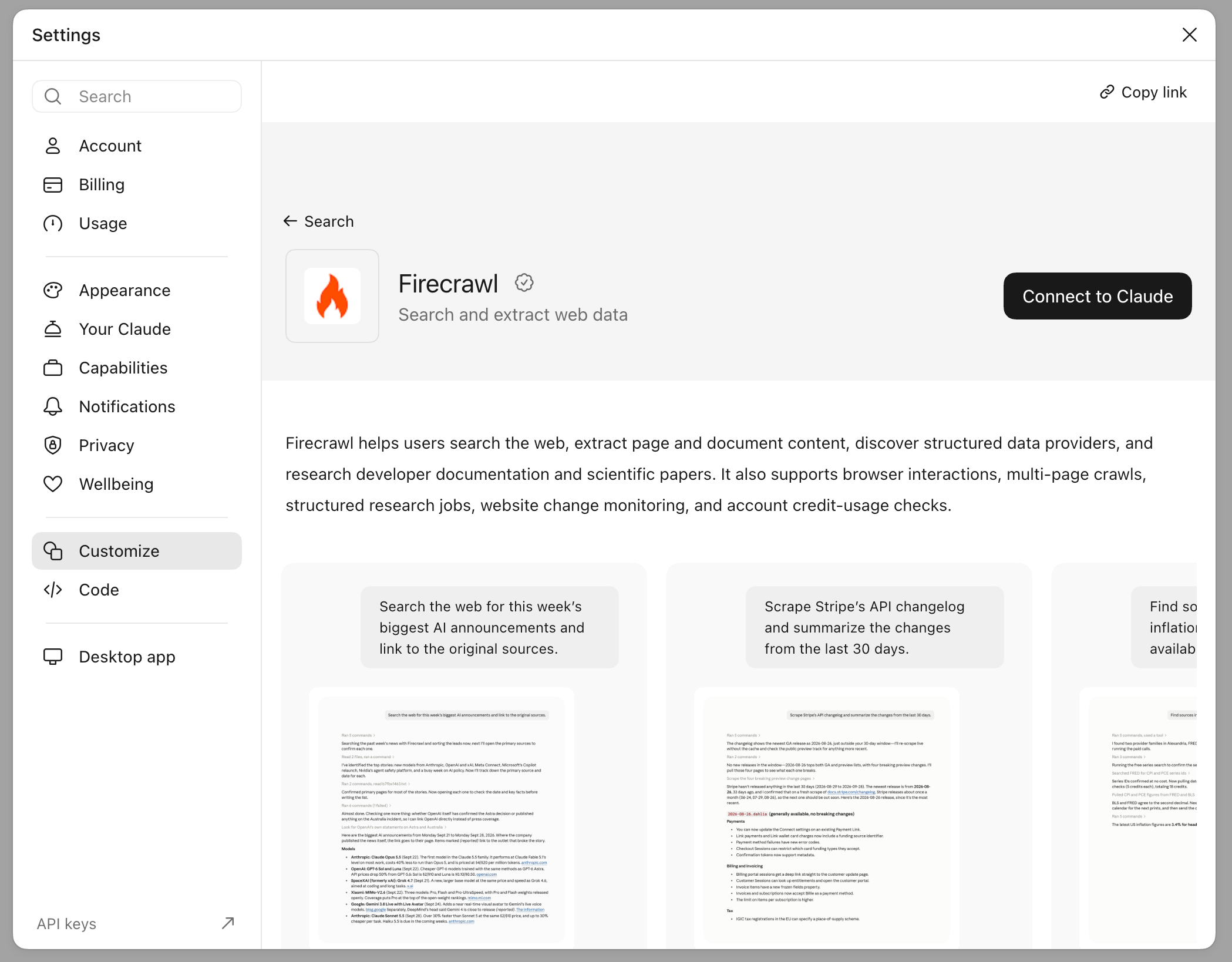
Click Connect to Claude. It opens a normal Firecrawl login. I signed in with Google, approved the access, and it dropped me back in Claude with the connector added. If you already have a Firecrawl account, it’s a minute.
Step 2: Know what terms you’re under, because nobody will ask
Through the API, Apollo and FullEnrich calls come back with THIRD_PARTY_DATA_TERMS_REQUIRED until you accept their terms. I had a paragraph ready telling you to accept them by hand instead of letting the agent click through.
It never came up. Three searches and two paid matches later, nobody had shown me a single term.
These are terms about what you’re allowed to do with people’s contact data, and you’re bound by them whether a dialog box appeared or not. They’re short, and I went through them in the Universal Scrape post. And maybe my acceptance of the terms for that post covered using Headless Clay, which is why I didn’t see them this time.
Step 3: Search, and say out loud that it has to be free
The prompt does two jobs. It describes who you want, and it fences the agent into the free call:
Use Firecrawl's Apollo people/search to find [JOB TITLES] at
[KIND OF COMPANY] in [COUNTRY OR CITY].

Only use people/search. It costs 0 credits. Do not call people/match,
bulk-match, or any FullEnrich or other paid tool in this step.
Show me name, title, and company for each result.
The second paragraph is there because an agent told to “find leads” will reasonably try to finish the job, and finishing the job costs credits.
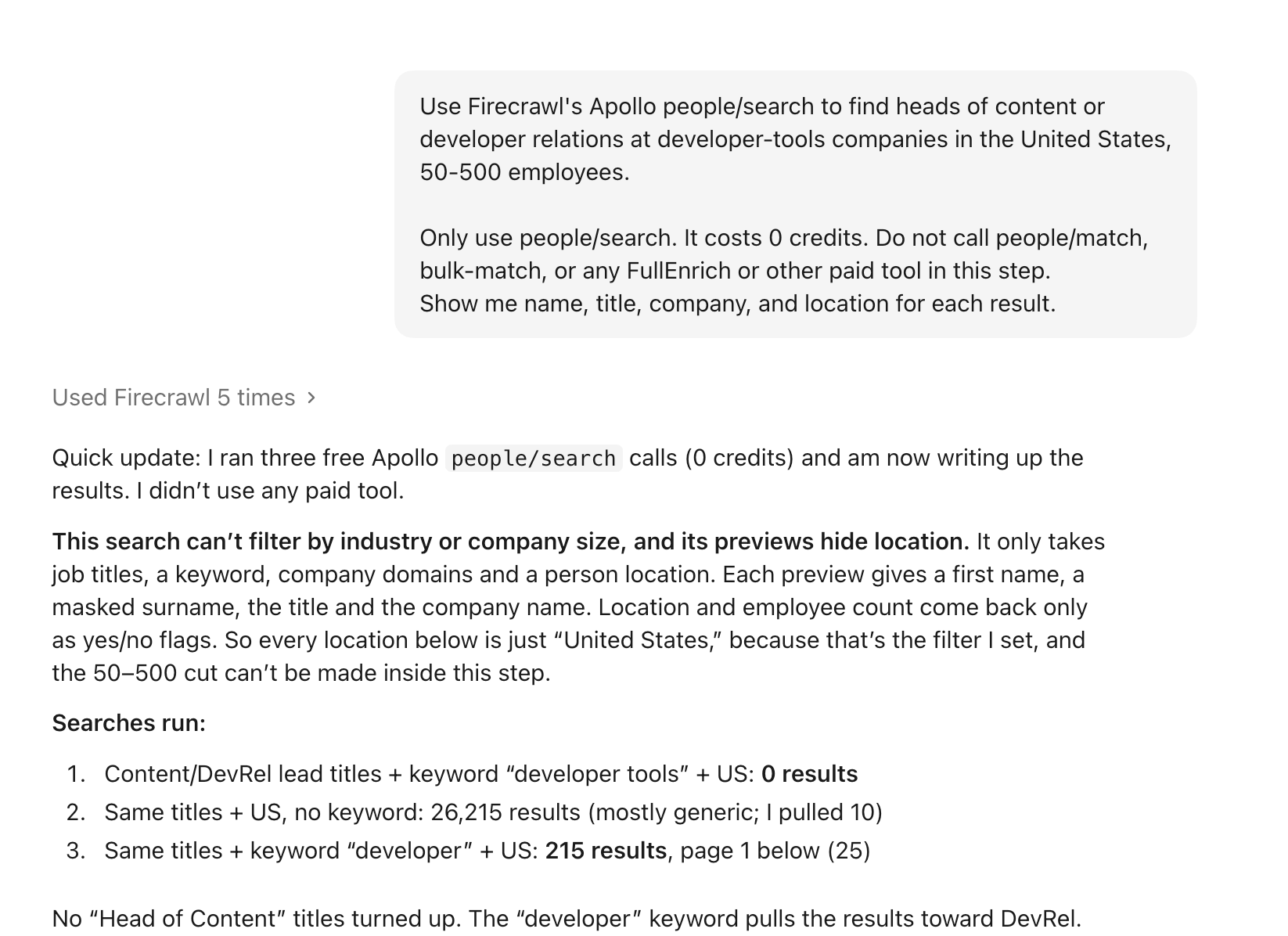
I went looking for people I might pitch writing work to: heads of content or developer relations at US developer-tools companies with 50 to 500 employees. Half of that request was impossible.
Apollo’s search only takes four things: job titles, a keyword, company domains, and a person location. There’s no industry filter and no company-size filter. And the previews are thinner than I expected. You get a first name, a masked surname, the title and the company name. Location and employee count come back as yes/no flags, not values. So “50 to 500 employees” can’t be checked in the free step at all, and “location” in the results just means “matched the filter you set.”
Claude ran three searches to find a shape that worked:
| Search | Results |
|---|---|
| Content and DevRel titles, keyword “developer tools”, US | 0 |
| Same titles, no keyword, US | 26,215 |
| Same titles, keyword “developer”, US | 215 |
The two-word keyword killed everything. No keyword drowned me. A one-word keyword landed in the middle, and it pulled the results hard toward DevRel. Not one “Head of Content” came back.
It stayed on the free call the whole time. My credit count was the same before and after. Better, it noticed that Apollo’s companies/search could do the size filter, said it costs 30 credits a page, and didn’t run it. That’s the fence in the prompt doing its job.
Step 4: Qualify before you pay
A spreadsheet makes you do this step by eye. In chat you can just ask:
From these results, which five are the best fit for [WHAT YOU SELL]?
Rank them and give one sentence of reasoning for each, based only on
title, company, and anything else people/search returned.
Don't look anything else up yet.
The cut is where the credits get saved. Twenty search results checked by hand is free. Twenty matched is 600 credits, most of a month, spent on people you were going to throw out anyway.
Claude was upfront about what it had to work with. The previews carry a title, a company name, a last-refreshed date and a handful of yes/no flags. Everything it said about what Semgrep or Descope actually does came from its own head, not from Apollo, and it said so before the list.
Two of those flags are the most useful thing in the free step. has_email: true means Apollo has an email for that person, so you’re not about to pay 30 credits to learn it doesn’t. All five picks had it. And the refresh date tells you how stale the record is. Claude used both without being asked, and docked one pick because has_city was false.
One quirk if you’re reading previews yourself: the surname masking keeps the first two letters and the last one. A three-letter surname has nothing left to hide, so it comes through whole.
I didn’t cut any of them. All five were companies I’d pitch, and the two I’d go to first were the ones Claude sold hardest: Chainguard (“a technical niche that rewards specialist writers”) and Arize (AI evaluation, “a hot topic where technical posts get read”). So those are the two I paid for.
Step 5: Pay for the survivors
Run Apollo people/bulk-match on the top two only, using the Apollo IDs
from the search. Don't reveal personal emails or phone numbers.
Tell me the credit cost before you run it.
Matching by the ID from the search is what Apollo’s own tool description says to prefer, ahead of a LinkedIn URL or an email. A name on its own needs a company domain next to it, or it matches the wrong person.
Claude didn’t just quote the price. It stopped. Thirty credits per matched person, up to 60 for the two, and “reply go and I’ll make the two calls.” It also pointed out that people/bulk-match costs the same and doesn’t charge for a miss, which is why the prompt above says bulk-match. Mine didn’t. Then it switched off the personal email and phone reveals on its own, because those cost extra.
Both matched. Sixty credits. For that you get the full name, the title and when they started it, a work email with a verification status, location, LinkedIn and Twitter handles, the job history, and Apollo’s record for their company: headcount, funding, valuation.
Then I asked Claude for my balance, and it couldn’t tell me. What it could do was add up its own session: 60 credits, both on the matches, and creditsCost: 0 on every other call. For the balance, go to the usage page on your Firecrawl dashboard. Mine showed the 60 used right away, but the remaining count took a while to catch up.
And this is where the free qualification came back to bite me. Both picks had a problem I could only see after paying:
- Chainguard is about 920 employees, with $892M raised. Claude had guessed it fit the 50 to 500 range from what it “knew” about the company. It didn’t. The free step can’t check company size, so that guess was the agent’s memory, not data.
- Apollo attached the wrong company to the Arize pick. The person was right: right email domain, right city, right career. But the company record was an Australian PR agency also called Arize. So the headcount Apollo gave me was for somebody else.
- Both email domains are catch-all. “Verified” on a catch-all domain means the server accepts mail for any address, so it’s a weaker promise than it sounds.
The recipe still holds. The cut in Step 4 is a guess, and a good one, but a guess. If company size matters to you, that’s the one thing worth 30 credits to check before the person: Apollo’s companies/search on your shortlist of companies, then search people at the ones that pass.
You Couldn’t Scrape LinkedIn. Now You Can Buy It in Chat.
In September I pointed Firecrawl at 31 sites that scraping use cases tend to target: ticket resellers, sneaker markets, real estate listings, job boards. Twenty-seven worked with a plain request. Three needed the stealth proxy. One refused outright, and it was LinkedIn: “We apologize for the inconvenience but we do not support this site.”
That’s not a block a flag gets you past. It’s a vendor decision. And it killed the easiest version of the lead generation recipe this series was supposed to have, which is why it took until November to write.
Now look at what FullEnrich’s tools take as input. people/lookup resolves a person “from a LinkedIn URL or ID.” contacts/work-email finds a verified work email “from a LinkedIn URL.” people/match matches “an exact LinkedIn profile URL.” Apollo’s companies tools take a LinkedIn company URL.
So the data Firecrawl won’t scrape comes back to you through a provider that licensed it. You hand over the LinkedIn URL you found yourself, and you get the profile back for 10 credits or the work email for 30.

The Fine Print Comes With the Emails
Both providers let you use the data for your own sales work. Neither lets you share it.
- Apollo allows storing and caching for internal sales use. It never allows publishing or exposing the data outside your organization, and the schedule calls out an agent’s output specifically.
- FullEnrich has the same shape: no publishing, no sharing with any third party.
- Data Legion lets you store results only in your CRM or internal systems.
For a salesperson filling their own pipeline, none of that gets in the way. For a few other ideas this recipe hints at, it’s fatal:
- A public directory of “every CTO in Ohio” is out.
- A lead list you build for a client is sharing with a third party, so it’s out.
- An agent that drops enriched contacts into a shared Slack channel with a contractor in it is murkier than you’d like.
It’s also why this post has no real email addresses in it. I’m not allowed to show them to you.
Is It Really 88% Cheaper Than Clay?
The launch page’s footnote compares Firecrawl Standard billed annually against Clay’s Launch plan, assumes a typical enriched record costs 6 to 20 Clay credits, and uses list prices as of November 2. I redid the arithmetic from both pricing pages.
Firecrawl Standard, annual: $990 a year for 100,000 credits a month. That’s $0.000825 a credit. A profile plus a work email runs 30 to 35 credits, so about 2.5 to 2.9 cents a record.
Clay Launch, annual: $167 a month, of which $113 is the data side. Clay’s pricing page lists that tier’s Data Credits as both “3K/mo” and “30K/yr,” which don’t agree, and one third-party breakdown says 2,500 a month. Call it $0.038 to $0.045 a credit. At 6 credits a record that’s 23 to 27 cents. At 20 it’s 75 to 90 cents.
So the claim holds: 87 to 89% cheaper at the low end, around 97% at the high end. Clay doesn’t publish what a work email actually costs in its credits, so the 6-to-20 range is the soft spot. Third parties put a single-provider email at 2 to 3 Data Credits and a three-provider waterfall at 4 to 8.
The phrase doing the work is “at scale.” Hobby is $19 for 5,000 credits, or $0.0038 a credit, and that puts a 30-credit email at about 11 cents. Still cheaper than Clay’s low end. Nowhere near 88%.
Why Not Just Use Apollo’s Own Connector?
“Enrichment inside Claude” isn’t new. Clay shipped in ChatGPT last December and in Claude in January. Apollo has had its own Claude connector since February.
What Firecrawl’s version has going for it:
- The search is free and the misses are free. With the free-first flow, you only pay for people you chose.
- It’s one connector for a dozen providers. If Apollo doesn’t have the person, FullEnrich or People Data Labs might, and you don’t install anything else.
- The same connector scrapes. Qualify a company by reading its pricing page or its careers page, then enrich the person who works there, in one conversation.
When you wouldn’t bother: if you already pay for Apollo, its own connector uses the seat you’re already paying for, and none of this saves you anything.
Where This Leaves the Recipe
The free-first flow worked. Three searches, two catalog lookups, and the qualify step cost nothing. The whole run cost 60 credits, and every one of them went to people I’d email.
And I probably will use it, because it fills a hole I already knew I had. In July I built a Claude skill to find freelance writing clients: developer-tools and AI infrastructure companies that need technical content. Its first run went through about 160 companies and scored 41 of them. The note I left in its run log says why: “research finds names but never addresses, so every batch stalls at the same step.”
That’s exactly this step. The skill already picks the companies, and Apollo’s free search takes company domains as a filter. So the skill finds the companies, the free search finds who runs content or DevRel there, I cut the list down, and I pay 30 credits for each person I’m going to write to. The part I was missing costs about a dollar a contact.
It also comes with the same lesson my skill’s log already taught me: an agent’s read on a company fails about half the time. Here it was the headcount and the wrong Arize. In July it was “stale” blogs that weren’t. Check before you send.
One rule this series started with was to check the catalog before you write a scraper. Universal Scrape added a second one: read the terms before you build anything that stores the data. Headless Clay adds a third, and it’s the cheapest: let the free call do the looking first.

* This website contains affiliate links. This means that if you click on a link and purchase a product or service, I may receive a small commission at no extra cost to you. Please note that I only recommend products and services that I believe in and that will add value to my readers. Not all links on this website are affiliate links. Learn more.
Related Posts

Firecrawl Universal Scrape Can Read Podcasts. The Terms Say You Can't Keep Them.
Universal Scrape puts podcasts, contact records, traffic and financials behind one scrape call. I read the terms for every paid provider. Half forbid what a ...

Before You Write a Scraper, Check Firecrawl Alexandria
Firecrawl's Alexandria sells the structured version of data you'd otherwise scrape: model benchmarks, app reviews, economic data, company records. Browsing i...

Track New AI Models on the Arena Leaderboard With a 70-Line Scraper
A scraper only ever tells you "now." Here's the 70-line harness that turns the Arena leaderboard into "what just showed up," with Firecrawl and SQLite.